|
|
PhoenixMicroBenchmark
2.0.0
Toolset for C++ function micro-benchmarking
|
|
|
PhoenixMicroBenchmark
2.0.0
Toolset for C++ function micro-benchmarking
|
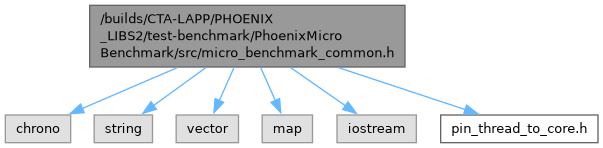
#include <chrono>#include <string>#include <vector>#include <map>#include <iostream>#include "pin_thread_to_core.h"Go to the source code of this file.
Typedefs | |
| typedef void(& | EvaluateTimeFct) (size_t) |
| typedef double(& | EvaluateTimeFct2d) (size_t, size_t) |
| typedef std::map< double, size_t > | MapOrderedTime |
| Map of the ordered ellapsed time. | |
| typedef std::vector< double > | VecEllapsedTime |
| Vector of ellapsed time measurement. | |
Functions | |
| void | micro_benchmarkComputeTime (double &ellapsedTimeNs, double &ellapsedTimeErrorNs, const MapOrderedTime &mapOrderTime, size_t nbValueToBeUsed) |
| Compute the total computing time and associated error with the given data. | |
| int | micro_benchmarkParseArg (int argc, char **argv, EvaluateTimeFct evalFunc) |
| Call the evalFunc by respect to the arguments given to the program. | |
| int | micro_benchmarkParseArg2d (int argc, char **argv, EvaluateTimeFct2d evalFunc) |
| Call the evalFunc by respect to the arguments given to the program. | |
| void | micro_benchmarkVecToMap (MapOrderedTime &mapOrderTime, const VecEllapsedTime &vecTime) |
| Fill the map of ordered time with the vector. | |
| typedef void(& EvaluateTimeFct) (size_t) |
Definition at line 23 of file micro_benchmark_common.h.
| typedef double(& EvaluateTimeFct2d) (size_t, size_t) |
Definition at line 24 of file micro_benchmark_common.h.
| typedef std::map<double, size_t> MapOrderedTime |
Map of the ordered ellapsed time.
Definition at line 21 of file micro_benchmark_common.h.
| typedef std::vector<double> VecEllapsedTime |
Vector of ellapsed time measurement.
Definition at line 19 of file micro_benchmark_common.h.
| void micro_benchmarkComputeTime | ( | double & | ellapsedTimeNs, |
| double & | ellapsedTimeErrorNs, | ||
| const MapOrderedTime & | mapOrderTime, | ||
| size_t | nbValueToBeUsed ) |
Compute the total computing time and associated error with the given data.
| [out] | ellapsedTimeNs | : ellapsed time in ns |
| [out] | ellapsedTimeErrorNs | : error on the ellapsed time in ns |
| mapOrderTime | : map of the ordered ellapsed times | |
| nbValueToBeUsed | : number of values to be used in the map to compute the performance of the function |
Definition at line 32 of file micro_benchmark_common.cpp.
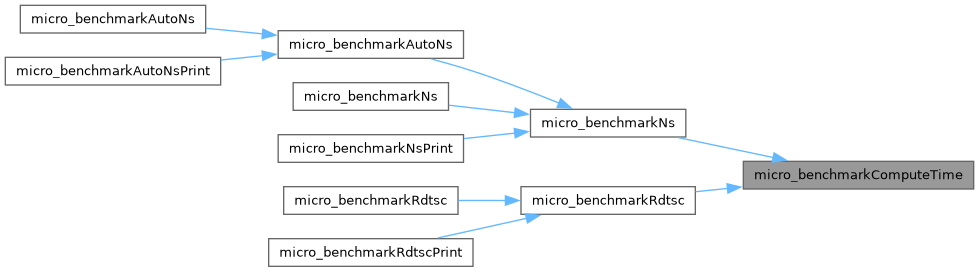
Referenced by micro_benchmarkNs(), and micro_benchmarkRdtsc().
| int micro_benchmarkParseArg | ( | int | argc, |
| char ** | argv, | ||
| EvaluateTimeFct | evalFunc ) |
Call the evalFunc by respect to the arguments given to the program.
| argc | : number of arguments passed to the program |
| argv | : table of arguments passed to the program |
| evalFunc | : function which evaluates the performance of an other function |
Definition at line 92 of file micro_benchmark_common.cpp.
References cutStringOnChars(), micro_benchmarkHelpFunction(), and PIN_THREAD_TO_CORE.
| int micro_benchmarkParseArg2d | ( | int | argc, |
| char ** | argv, | ||
| EvaluateTimeFct2d | evalFunc ) |
Call the evalFunc by respect to the arguments given to the program.
| argc | : number of arguments passed to the program |
| argv | : table of arguments passed to the program |
| evalFunc | : function which evaluates the performance of an other function |
Definition at line 124 of file micro_benchmark_common.cpp.
References cutStringOnChars(), micro_benchmarkHelpFunction2d(), and PIN_THREAD_TO_CORE.
| void micro_benchmarkVecToMap | ( | MapOrderedTime & | mapOrderTime, |
| const VecEllapsedTime & | vecTime ) |
Fill the map of ordered time with the vector.
| [out] | mapOrderTime | : map of the ordered ellapsed times |
| vecTime | : input ellapsed times |
Definition at line 15 of file micro_benchmark_common.cpp.
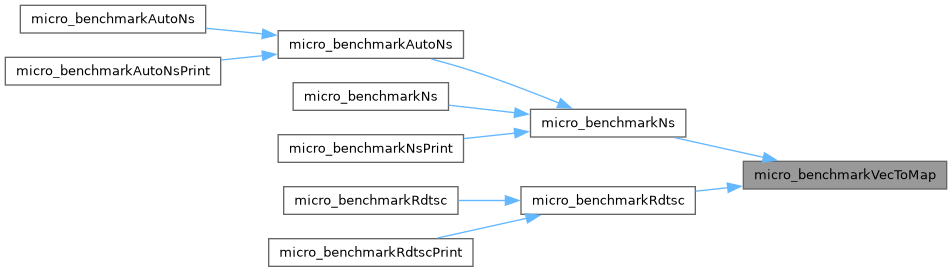
Referenced by micro_benchmarkNs(), and micro_benchmarkRdtsc().
 1.17.0