|
|
PhoenixMicroBenchmark
2.0.0
Toolset for C++ function micro-benchmarking
|
|
|
PhoenixMicroBenchmark
2.0.0
Toolset for C++ function micro-benchmarking
|
Go to the source code of this file.
Macros | |
| #define | PHOENIX_MINIMUM_TIME_NS 1000000000.0 |
| Minimum time for performance test in ns. | |
Functions | |
| template<typename _Callable, typename... _Args> | |
| void | micro_benchmarkAutoNs (double &ellapsedTimeNs, double &ellapsedTimeErrorNs, _Callable &&__f, _Args &&... __args) |
| Do the micro benchmarking of a given function and gives performance results in ns. | |
| template<typename _Callable, typename... _Args> | |
| void | micro_benchmarkAutoNs (double &ellapsedTimeNs, double &ellapsedTimeErrorNs, double &timePerElement, double &timeErrorPerElement, size_t nbElement, _Callable &&__f, _Args &&... __args) |
| Do the micro benchmarking of a given function and gives performance results in ns. | |
| template<typename _Callable, typename... _Args> | |
| void | micro_benchmarkAutoNsPrint (const std::string &testName, size_t nbElement, _Callable &&__f, _Args &&... __args) |
| Do the micro benchmarking of a given function and gives performance results in ns and print the result. | |
| template<typename _Callable, typename... _Args> | |
| void | micro_benchmarkNs (double &ellapsedTimeNs, double &ellapsedTimeErrorNs, double &timePerElement, double &timeErrorPerElement, size_t nbTestPerf, size_t nbCallPerTest, size_t nbElement, _Callable &&__f, _Args &&... __args) |
| Do the micro benchmarking of a given function and gives performance results in ns. | |
| template<typename _Callable, typename... _Args> | |
| void | micro_benchmarkNs (double &ellapsedTimeNs, double &ellapsedTimeErrorNs, size_t nbTestPerf, size_t nbCallPerTest, _Callable &&__f, _Args &&... __args) |
| Do the micro benchmarking of a given function and gives performance results in ns. | |
| template<typename _Callable, typename... _Args> | |
| void | micro_benchmarkNsPrint (const std::string &testName, size_t nbTestPerf, size_t nbCallPerTest, size_t nbElement, _Callable &&__f, _Args &&... __args) |
| Do the micro benchmarking of a given function and gives performance results in ns and print the result. | |
| template<class T> | |
| void | phoenix_doNotOptimize (T &value) |
| Prevent compiler from optimising a loop. | |
| template<class T> | |
| void | phoenix_doNotOptimize (T const &value) |
| Prevent compiler from optimising a loop. | |
| #define PHOENIX_MINIMUM_TIME_NS 1000000000.0 |
Minimum time for performance test in ns.
Definition at line 14 of file micro_benchmark_ns_impl.h.
Referenced by micro_benchmarkAutoNs().
| void micro_benchmarkAutoNs | ( | double & | ellapsedTimeNs, |
| double & | ellapsedTimeErrorNs, | ||
| _Callable && | __f, | ||
| _Args &&... | __args ) |
Do the micro benchmarking of a given function and gives performance results in ns.
| [out] | ellapsedTimeNs | : ellapsed time in ns |
| [out] | ellapsedTimeErrorNs | : error on the ellapsed time in ns |
| __f | : function to be called and benchmarked | |
| __args | : parameter of the function to be benchmarked This function tries to find automatically a relevant performance measurement |
Definition at line 81 of file micro_benchmark_ns_impl.h.
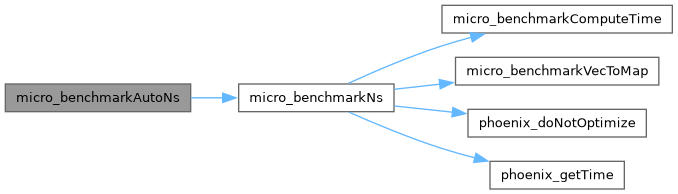
References micro_benchmarkNs(), and PHOENIX_MINIMUM_TIME_NS.
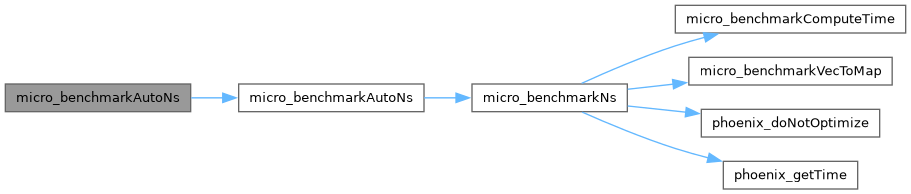
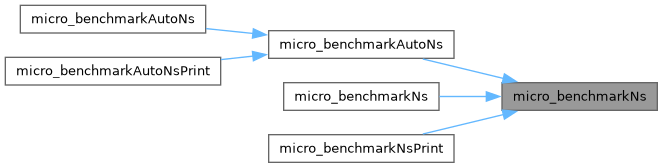
Referenced by micro_benchmarkAutoNs(), and micro_benchmarkAutoNsPrint().
| void micro_benchmarkAutoNs | ( | double & | ellapsedTimeNs, |
| double & | ellapsedTimeErrorNs, | ||
| double & | timePerElement, | ||
| double & | timeErrorPerElement, | ||
| size_t | nbElement, | ||
| _Callable && | __f, | ||
| _Args &&... | __args ) |
Do the micro benchmarking of a given function and gives performance results in ns.
| [out] | ellapsedTimeNs | : ellapsed time in ns |
| [out] | ellapsedTimeErrorNs | : error on the ellapsed time in ns |
| [out] | timePerElement | : time per element in ns |
| [out] | timeErrorPerElement | : error of time per element in ns |
| nbElement | : number of element treated by the function __f | |
| __f | : function to be called and benchmarked | |
| __args | : parameter of the function to be benchmarked |
Definition at line 148 of file micro_benchmark_ns_impl.h.
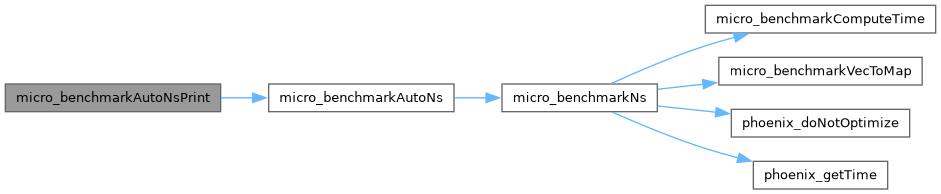
References micro_benchmarkAutoNs().
| void micro_benchmarkAutoNsPrint | ( | const std::string & | testName, |
| size_t | nbElement, | ||
| _Callable && | __f, | ||
| _Args &&... | __args ) |
Do the micro benchmarking of a given function and gives performance results in ns and print the result.
| testName | : name of the performance test |
| nbElement | : number of element treated by the function __f |
| __f | : function to be called and benchmarked |
| __args | : parameter of the function to be benchmarked |
Definition at line 181 of file micro_benchmark_ns_impl.h.
References micro_benchmarkAutoNs().
| void micro_benchmarkNs | ( | double & | ellapsedTimeNs, |
| double & | ellapsedTimeErrorNs, | ||
| double & | timePerElement, | ||
| double & | timeErrorPerElement, | ||
| size_t | nbTestPerf, | ||
| size_t | nbCallPerTest, | ||
| size_t | nbElement, | ||
| _Callable && | __f, | ||
| _Args &&... | __args ) |
Do the micro benchmarking of a given function and gives performance results in ns.
| [out] | ellapsedTimeNs | : ellapsed time in ns |
| [out] | ellapsedTimeErrorNs | : error on the ellapsed time in ns |
| [out] | timePerElement | : time per element in ns |
| [out] | timeErrorPerElement | : error of time per element in ns |
| nbTestPerf | : number of performance test | |
| nbCallPerTest | : number of calls per performance test | |
| nbElement | : number of element treated by the function __f | |
| __f | : function to be called and benchmarked | |
| __args | : parameter of the function to be benchmarked |
Definition at line 129 of file micro_benchmark_ns_impl.h.
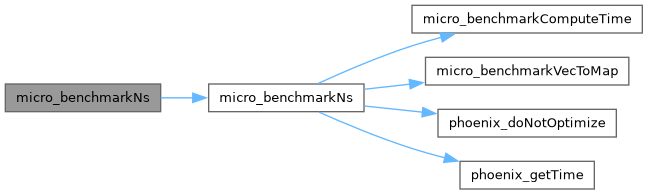
References micro_benchmarkNs().
| void micro_benchmarkNs | ( | double & | ellapsedTimeNs, |
| double & | ellapsedTimeErrorNs, | ||
| size_t | nbTestPerf, | ||
| size_t | nbCallPerTest, | ||
| _Callable && | __f, | ||
| _Args &&... | __args ) |
Do the micro benchmarking of a given function and gives performance results in ns.
| [out] | ellapsedTimeNs | : ellapsed time in ns |
| [out] | ellapsedTimeErrorNs | : error on the ellapsed time in ns |
| nbTestPerf | : number of performance test | |
| nbCallPerTest | : number of calls per performance test | |
| __f | : function to be called and benchmarked | |
| __args | : parameter of the function to be benchmarked |
Definition at line 45 of file micro_benchmark_ns_impl.h.
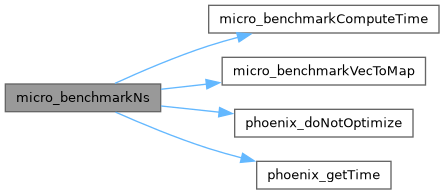
References micro_benchmarkComputeTime(), micro_benchmarkVecToMap(), phoenix_doNotOptimize(), and phoenix_getTime().
Referenced by micro_benchmarkAutoNs(), micro_benchmarkNs(), and micro_benchmarkNsPrint().
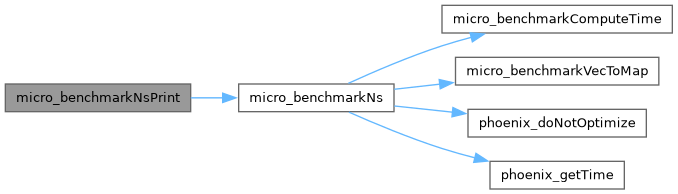
| void micro_benchmarkNsPrint | ( | const std::string & | testName, |
| size_t | nbTestPerf, | ||
| size_t | nbCallPerTest, | ||
| size_t | nbElement, | ||
| _Callable && | __f, | ||
| _Args &&... | __args ) |
Do the micro benchmarking of a given function and gives performance results in ns and print the result.
| testName | : name of the performance test |
| nbTestPerf | : number of performance test |
| nbCallPerTest | : number of calls per performance test |
| nbElement | : number of element treated by the function __f |
| __f | : function to be called and benchmarked |
| __args | : parameter of the function to be benchmarked |
Definition at line 166 of file micro_benchmark_ns_impl.h.
References micro_benchmarkNs().
|
inline |
Prevent compiler from optimising a loop.
| value | : reference to a value |
Definition at line 28 of file micro_benchmark_ns_impl.h.
|
inline |
Prevent compiler from optimising a loop.
| value | : reference to a value |
Definition at line 20 of file micro_benchmark_ns_impl.h.
Referenced by micro_benchmarkNs().
 1.17.0